DrupalCamp Spain 2025: A New Opportunity?

A reflection on the leading annual gathering for the Drupal community in Spain, held from September 18 to 20, 2025, in Santiago de Compostela, Galicia, with the Cidade da Cultura de Galicia serving as the event’s main venue.
Picture from Unsplash, user Anthony Ievlev, @onmywayhome
Table of Contents
1. Introduction
2. First impressions
3. Harkonnen City
4. Speakers and gender
5. The T-shirt and the pen
6. Food and groups
7. Content
8. The paradox of community and group/non-group
9. Closing thoughts (TL;DR)
10. Acknowledgements
11. Sources
12. :wq!
1. Introduction
It would be rather bold to write as though emotional memory could somehow be decoupled from experience. Contrary to what we have always been told, messenger and message are inextricably linked. Even if we have spent half our lives pretending otherwise, there is no way to engage with an idea without keeping in mind the person who first brought it to us. No way.
I suppose that is what is happening as I write these lines: I cannot separate my experience of DrupalCamp Spain 2025 from the fact that the gathering took place in Santiago de Compostela, a city I had not visited for nearly twenty-five years.
 Branding for DrupalCamp Spain 2025 - Santiago de Compostela
Memories begin to mingle: the arrival at Monte do Gozo, the Praza do Obradoiro, the Seminario Menor, the París–Dakar, and countless other scenes gathered along the nearly eight hundred kilometres between Roncesvalles and the city of the field of stars. As that old poem put it: “We, of that time, are no longer the same.”
I realise, then, that Santiago -the city- itself became a vehicle for the experience, making this DrupalCamp resonate more deeply and leaving me especially susceptible to emotional contagion. It must have shaped my observations, the way I experienced the event, how much I enjoyed it, what I learned, and the surprises I encountered… But now it is time to stop and reflect —on just a few things.
Reflecting on an event of this kind is complicated from the outset. Behind it lies an enormous amount of work, commitment, and debate, as well as many more absences —talking about things is always easier than doing them. Above all, there are so many people giving everything they can at every moment, and often a little more. The event has many facets, too many nuances to cover in full, and qualities that may even seem contradictory.
Still, with due care and respect, I think it is possible to examine some of the questions raised by an event like this and add one more grain of sand in the hope of building a beach. That is the sole purpose of this piece, so here we go!
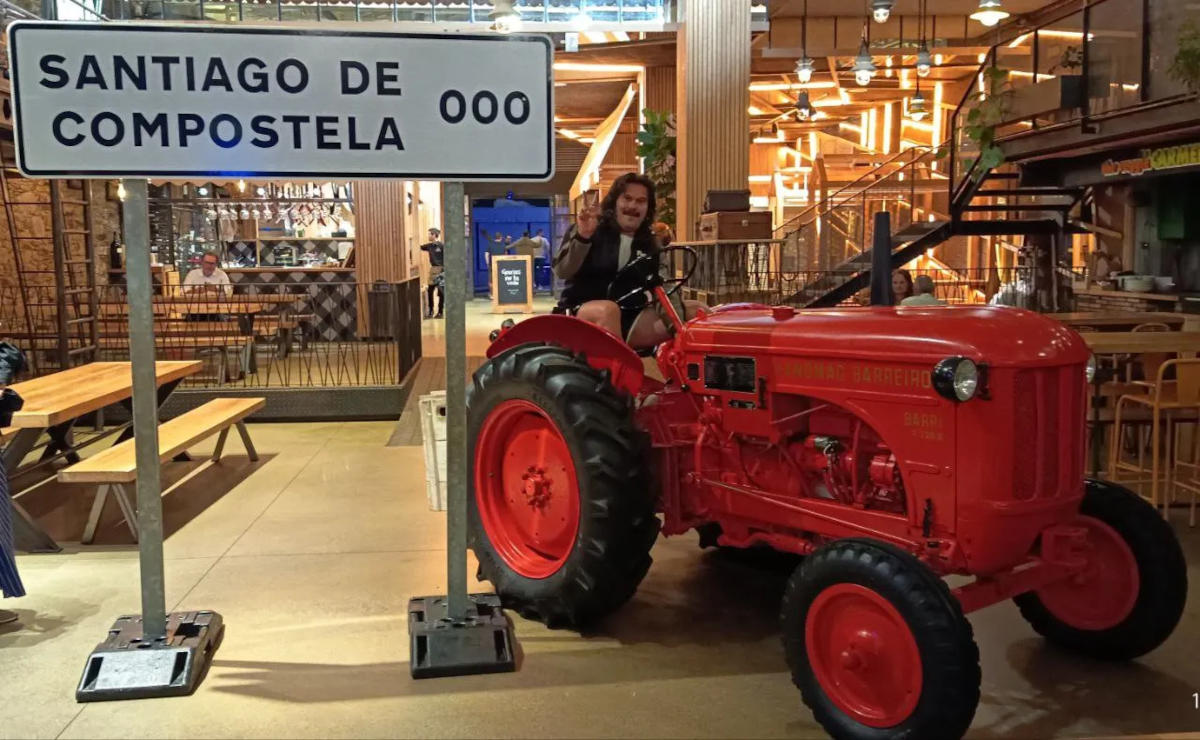 Ready for DrupalCamp Spain 2025 at Mercado Boanerges, Santiago de Compostela.
2. First impressions
Attending DrupalCamp Spain 2025 was not among my priorities —there is no point denying it or claiming otherwise. Yet every time I read a new publication, whether a LinkedIn post or an article on the event website, something similar happened: I felt warmth, kindness, and motivation. It was as if a host were being generous and, above all, as if those texts were not speaking specifically to me, to who I am or what I represent. And that was a very good thing.
Any effort to promote diversity and inclusion —the former usually being a consequence of the latter— begins long before the event itself. It generally starts with the organising group establishing clear, active policies from which actions, measures, and countermeasures will eventually emerge.
I do not know whether the communication factor arose from that declared intention or was merely accidental —it happened that way, it was one person’s isolated decision, and so on. In any case, I want to express my gratitude for the tone and messaging used throughout the communication campaign. I consider it an absolute success, a thoroughly sound choice.
I dwell on this point because, if its importance were fully understood and this one-off occurrence became a lasting practice —repeated over time and sustained— we would have a fundamental tool for improvement. The possibility of this becoming a permanent feature gives me hope: I want to believe it could receive the importance it truly deserves.
Kindness, affection, a didactic approach, openness in gendered language, and the use of forms that are never crude win the day.
Ultimately, this could improve matters such as those we will explore in the following sections. There are no isolated elements, situations, or concepts here. Everything maintains a dialectical relationship, a bond. Let us see how we might weave this interpretive web.
3. The Harkonnen City
The so-called venue, I mean the place where an activity happens, is not usually an especially interesting matter in itself. In this case, however, I cannot avoid pausing for at least a minute. If attendees were passengers and the organising team were the drivers, then the place in which the experience unfolds would be something like the vehicle we board for the journey.
This time, we were riding something that looked quite impressive at first sight.
I am referring, of course, to the vast, overwhelming, and excessive construction that is the Cidade da Cultura de Galicia: an unsettling intervention on one of the hills southeast of Santiago de Compostela’s historic centre, on the outskirts of a city of only one hundred thousand inhabitants. A colossus clad in white and beige quartzite, the epitome of imposing, distant, cold architecture.
A paradise of hostile architecture, the dream of the hard plaza operating as an empty stage with no spirit to inhabit it.
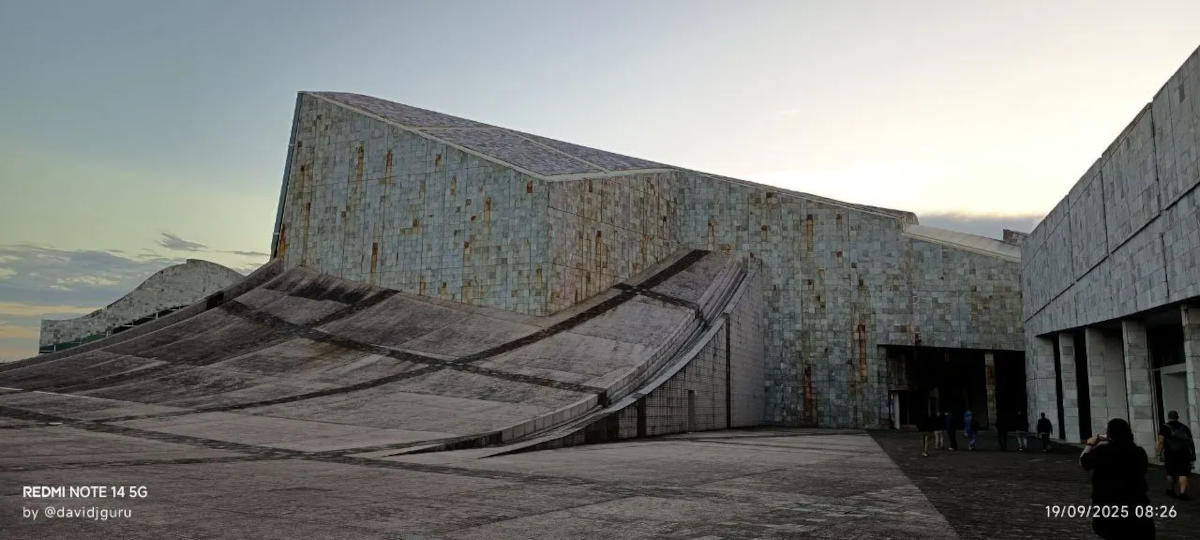 Cidade da Cultura de Galicia in the early morning, Santiago de Compostela.
Quite apart from its limited use —real, practical, complete— its dead spaces, and its lack of genuine operability (libraries open during the weekend in a place not served by bus lines throughout the day), we should apply the old POSIWID principle [1] of systems assessment. Coined by Stafford Beer, it holds that a system should be judged by what it actually does, rather than by its initially declared aims: “The purpose of a system is what it does.”
I therefore assume that one of its genuinely successful purposes must have been to increase the wealth of some human subgroup. As an objective, it seems to have been achieved rather well.
It also works as an excellent warning. It brings back to the senses the distinctly property-driven fantasy of a nation: the construction intended to become a landmark with enormous impact, an underused structure down whose drain disappeared what might have been but never —under any circumstances— could have become.
In this respect, enormous thanks are due to the event organisers for solving the collective transport problem with adapted and scheduled services to the venue. Without them, getting there would have been impossible (bus line 9 up Monte Gaiás, for instance, runs only once an hour on Saturdays and only until 1:30 p.m.).
4. Speakers and gender
One of the previous questions concerned the ways in which we invite people: How we make others feel motivated to attend our gathering. Let us ask the complementary question: who attended? Unfortunately, I do not have attendance figures, but we can examine the publicly available information and try to put it in context.
Women accounted for almost 27% of the speakers. That is moderately good, or at least not-too-bad, because it approaches the current global average for large technology events, where women represent around 30–33% of speakers. [2] [3]
That 27% may be a trap. It might match the usual figures in STEM education and careers, but classifying it as a “structural,” chronic problem about which we can do nothing merely removes the possibility of designing interventions. We have seen this too many times: placing the specific issues within the abstract and rejecting specific interventions in favour of a comprehensive solution that, predictably, never arrives.
Support for care responsibilities —childcare, nurseries, activities for children, and so forth— is crucial to making attendance possible. People carrying the heaviest care burden easily lose this constant rat race that is technology.
Although there is a long and difficult road ahead —racialised women, minorities, underrepresented groups, and more— DrupalCamp Spain 2025 seems to occupy an intermediate position: neither as low as the ceiling in some sectors nor as high as at technology events strongly focused on gender diversity. The 2025 Mobile World Congress, for example, reported 41%, almost 500 women among 1,200 speakers. [4]
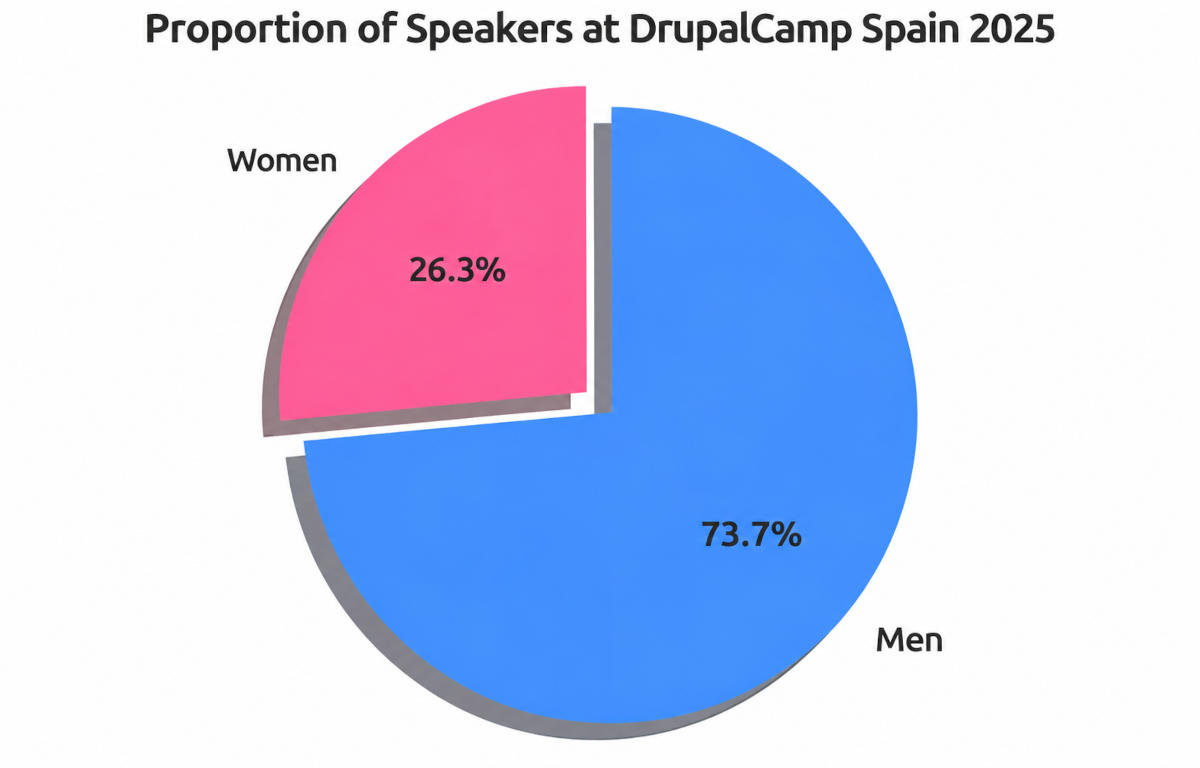 Approximate gender distribution of speakers at DrupalCamp Spain 2025.
We have focused on gender simply to begin with one dimension, but other pending dimensions are not even on our radar yet: neurodivergence, disability, or the positive, active inclusion of psychiatric survivors. We remain far from this and, because of our own moral poverty, usually prefer to keep mad people at a distance —they are the only ones who tell the truth.
It is equally important that this terminology should at least begin to feel familiar. As scholars of critical event studies argue [5], our success will not be measured by ROI or vague general figures. It will be measured by our capacity to include non-hegemonic population groups. I use the future tense because the present is deplorable.
5. The T-shirt and the pen
Let me praise, right now, the operational decision not to hand out more merchandise (swag) than necessary —or almost none. Enough of the notebook in which we will write nothing, the pen languishing on our desk, the tote bag we will never use, and the T-shirt of questionable aesthetic ambition —on this point I will accept no subjectivity— that will become part of our sleepwear. Agur.
It is over, and I genuinely hope it does not return. In this late-capitalist world where everything is burning —literally— perhaps we will gradually understand the importance of producing and buying only what is fair, necessary, and essential. If anything must burn, let it be old habits. Beti.
I know that some people collect T-shirts from these events —some even defend the practice publicly— but I do not think we should be accommodating this well-known and dangerous paraphilia. Gero arte.
I would go further: I would ask the companies involved not to dress their employees in corporate T-shirts. In addition to the stated consumption concerns, there is the undeniable fact that these shirts merely help compact the attending group, reinforce isolation from other groups, and embody the dreadful metaphor of homogenisation.
I honestly do not believe this small form of business corporatism, with its militarised spirit, helps broaden the realm of what is possible. Breaking homogeneity should be one of our key goals. Who the cap fit.
6. Food and groups
For the record, I am not vegan or even vegetarian. But I cannot understand the actual need to eat meat; even a die-hard barbecue or football fan might acknowledge as much.
If everyone can meet in the base case, the MVP with the strictest constraints —if all of us can eat vegan food, subject only to possible food allergies, for a given period of two days— why not do it? It is difficult to accept that in 2025 we are still segregating groups, even physically separating people who choose vegan or vegetarian food into their own subset away from everyone else merely so that they can be served differently.
I know that catering at an event is complicated and highly involved from a management perspective. Many variables must be balanced and many cases accommodated. I also know the different positions: those who see no problem —members of the hegemonic group, so to speak— and those who argue that food should be removed from event planning and left to each individual.
I am not convinced that this would be the most efficient approach, and I fear it would affect attendance by underrepresented subgroups even more. I would instead manage the default option by setting the baseline at vegan solutions for everyone, without distinction. More restrictive diets —such as fruitarianism [6]— may require temporary adaptation, and so on.
We need to guide our suppliers through conversation towards more efficient, cross-cutting, and inclusive solutions. We need base cases that respect constraints —allergies, nutrition, and so on— while constituting real progress. Nothing terrible will happen if we are all vegan for one day —or two.
7. Content
Leaving possible clichés and commonplaces aside, I am at least satisfied that I tried to separate the wheat from the chaff and the smoke from the wind. Avoiding the usual traps of false meritocracy —which in almost every context tend to promote the man free of care responsibilities and sometimes even free of caring for himself— as well as the standard career paths and recognition within “Open Source”, I think I chose well among the workshops and talks.
Of the full programme and the sessions I attended, I would highlight the following for different reasons:
- Upgrading from Drupal 7 to Drupal 11 with the Migrate API, by Mauricio Dinarte.
- DDEV Aljibe: a complete local development environment, by Ricardo Sanz.
- The path towards implementing multilingual support in Drupal CMS, by Yolanda Gorriz and José Reyero. See video here.
- Sustainable Drupal contributions: from individual effort to agency strategy, by Pedro Cambra. See video here.
I could say many things about Mauricio Dinarte and his experience. Practically everything I know about Drupal migrations I learned from him by following his blog, his other content, and, of course, I was one of the first people to buy his digital book on the subject. It was an enormous joy to share a space with someone who travelled so far and was so eager to share.
Thank you to DrupalCamp Spain for bringing this expert to the event.
We could also point to the experience accumulated around Drupal by Ricardo Sanz and his crew at Metadrop. I mainly attended his workshop to follow up on a similar talk of his that I enjoyed a few years ago —at DrupalCamp Spain Zaragoza, if memory serves— about building ready-to-use, container-based local development environments for projects.
At the time, the tooling was based on Docker4Drupal. For those of us who had already moved to DDEV, seeing the transition to a validated, standardised stack was a delight. Whether DDEV Aljibe can become a de facto standard for operating Drupal projects will depend largely on the testing that the rest of us can do with the tool. Consider that noted.
From Yolanda Gorriz and José Reyero’s talk, I took away their clarifications about multilingual support in Drupal CMS, which I have already used as a foundation in several projects. At last, we have a clear map of what is happening, why, and the path being followed to resolve it all. They are tackling remarkable technological challenges in UX and software to implement an integrated solution.
Finally, I want to underline the central idea in Pedro Cambra’s talk, which I consider essential: companies must bear the direct and indirect costs of contributing to open source.
We should already be taking the next step: ensuring that the organizations benefiting most from the operational advantages of Open Source also take an active role in contributing to its development and long-term sustainability.
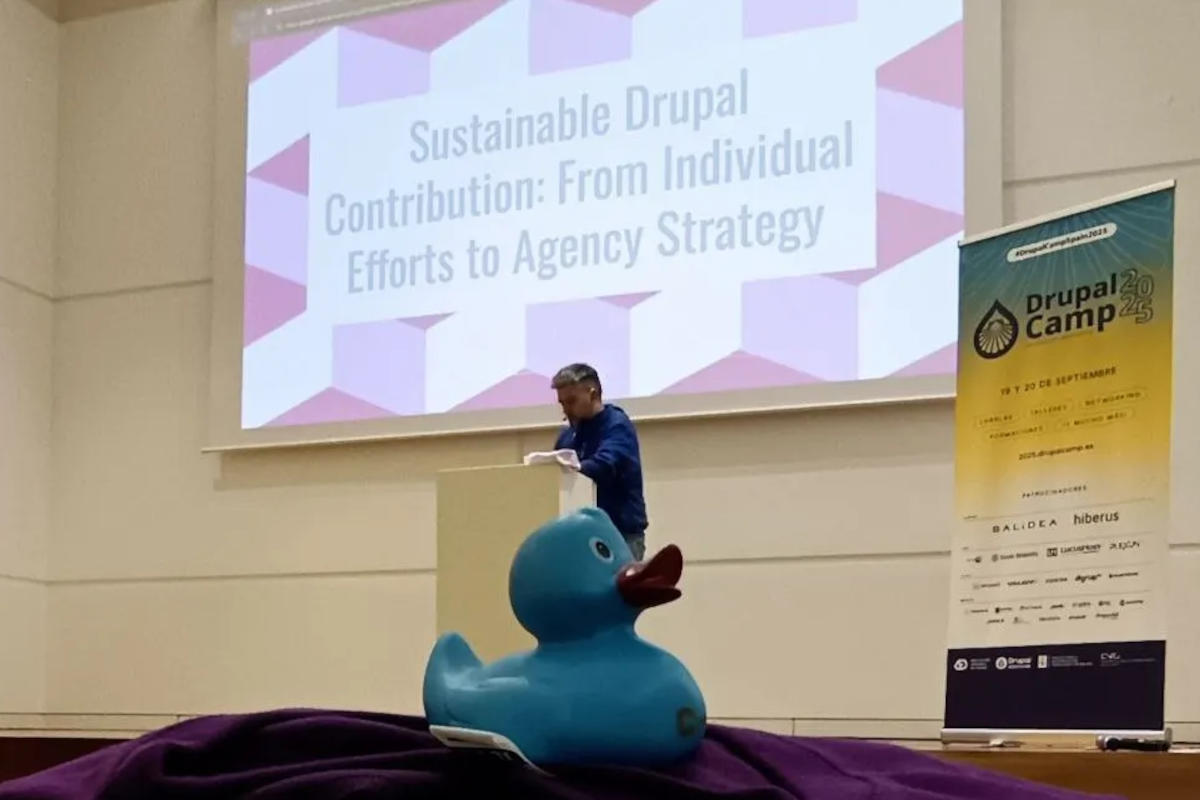 Pedro Cambra during his session on sustainable Drupal contributions.
We do not stand on the shoulders of giants; rather, we climb onto the weary backs of countless individuals, relying on their unpaid labour and personal time. In an ecosystem where the boundaries between professional work, paid employment, and personal passion increasingly blur, this raises a fundamental question about fairness, responsibility, and sustainability.
8. The paradox of community and group/non-group
As some of the people around me know well, at this point in my life I shudder whenever I return to Pekka Himanen’s influential The Hacker Ethic [7]. What once motivated me through the idea of shared knowledge later became an opportunity to capitalise on experience and, eventually, merely a recurring nightmare shaped like the Protestant work ethic.
I thought I was interpreting the future, but in fact I was only reading a refurbished version of Max Weber’s most catastrophic ideas.
My position is therefore fundamentally confused and still unresolved at this point in my life. I no longer know what actually binds us, and concepts such as “community” or “local group” now seem like abstractions to me. The implicit invitation to assume that an intersection of personal interests might produce a greater good does not exactly help clarify my assessment. Yet here we are, and there is unquestionably something shared in our hands.
From a dispassionate analytical perspective, the Spanish Drupal Association —AED by its Spanish initials— might be an interesting way to channel this. For anyone unfamiliar with it, DrupalCamp Spain always includes an AED assembly open to everyone, whether or not they are members. Members have speaking and voting rights; non-members may speak and participate in the debates and reflections that usually take place. A board following Spain’s formal association model brings forward the matters on which consensus and votes are required.
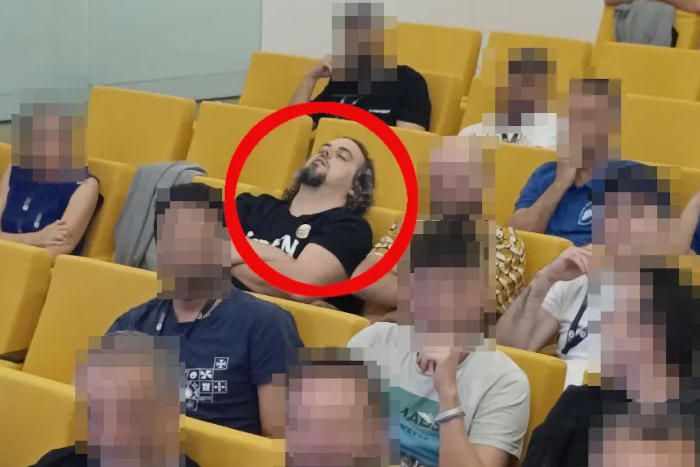 Astral travels during the AED assembly at DrupalCamp Spain 2025.
This year, a question emerged that I consider crucial and closely related to the event’s continuity: an invitation to rethink the DrupalCamp Spain production model in search of something far more realistic, efficient, and optimised.
This means leaving behind the recurring fantasy of the “local group” or “local community,” which in practice, when the gathering has to be organised, consists of only one or two people from the same area. Anyone who has organised a medium-sized event already knows this.
9. Closing thoughts (TL;DR)
Although I feel that many more ideas remain unwritten, I urgently need to bring this piece to a close: a final synthesis that can free me from typing and you from enduring this long ramble. If you made it this far, you have my heartfelt congratulations.
Even though it may not be immediately obvious and these observations form only one set of signals, I have the impression that a small breath of fresh air may be moving through the community. I do not know how well the clearly positive points will be used in the future, or whether we interpret at least some matters in a similar way. But my optimism chooses to believe that we do, and that we can improve the areas where we are still far from exemplary.
For those who arrived here by scanning for a quick read, here are a few simple closing notes:
- Communication: A reason for optimism.
- Swag: A smart choice.
- Content: Diverse.
- Venue: Impressive.
- Food: A recurring problem.
- Diversity: The major outstanding challenge.
- Experience: Rewarding.
…What more can I say? I think that pretty much wraps up my experience at DrupalCamp Spain 2025. Until next time — see you at the next one!
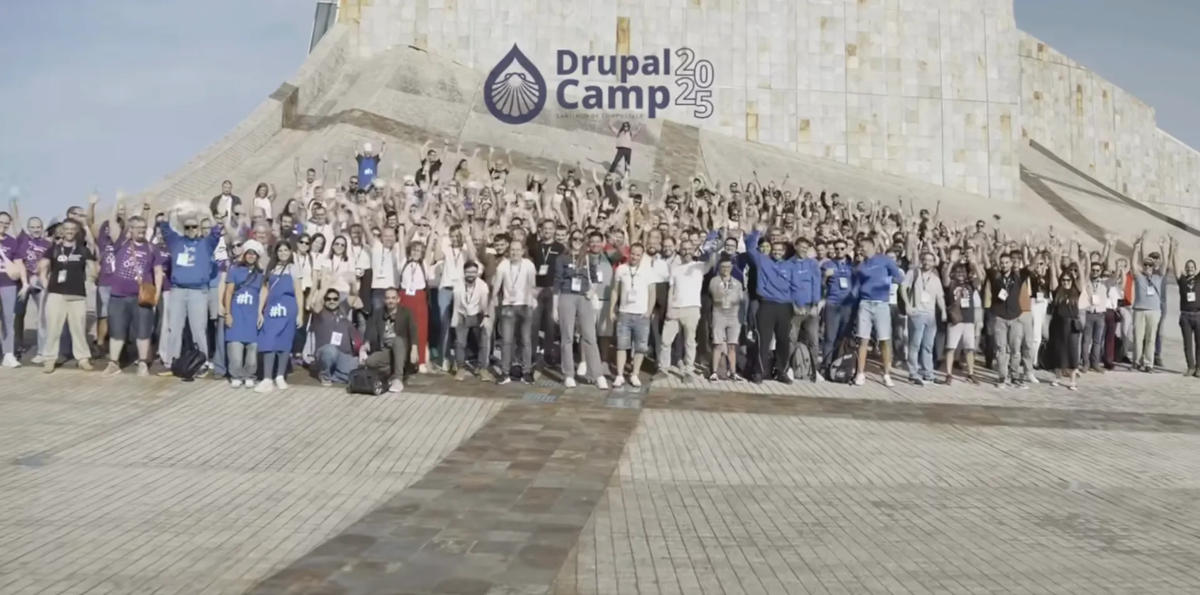 Group photo of DrupalCamp Spain 2025 attendees… I’m the one right at the back, at the very top.
10. Acknowledgements
- To the organising group, including the local people involved and the combined working teams across the core group and AED. Thank you for all the work you did. Thank you.
- To the Marketing Department at Universidad Tecnológica Atlántico-Mediterráneo (UTAMED) for enabling me to attend the event.
- To Óscar García Jiménez for so generously sharing his notes.
- To Rubén Eguiguren for being my friend and making me feel less alone at every gathering of this kind.
- To Pedro, for coming back.
11. Sources
[1] “The purpose of a system is what it does” — Wikipedia
https://en.wikipedia.org/wiki/The_purpose_of_a_system_is_what_it_does
[2] “The tech conference gender gap” (2024) — Pomona Partners
https://pomona.partners/updates/the-tech-conference-gender-gap-new-data-reveals-striking-disparities
[3] “Event Gender Diversity Study 2013–2019 (more than 60,000 event speakers, 58 countries, five continents, 45 industries)” — Bizzabo
https://www.bizzabo.com/blog/event-gender-diversity-study-2019
[4] “GSMA MWC25 Barcelona contributed €561 million to the Barcelona economy” — MWC25 Press Release
https://www.mwcbarcelona.com/articles/gsma-mwc25-barcelona-contributed-561-million-barcelona-economy
[5] “Accessibility, Inclusion, and Diversity in Critical Event Studies” — Edited by Rebecca Finkel, Briony Sharp, and Majella Sweeney
https://www.routledge.com/Accessibility-Inclusion-and-Diversity-in-Critical-Event-Studies/Finkel-Sharp-Sweeney/p/book/9781032338897
[6] “Fruitarianism” — Wikipedia
https://en.wikipedia.org/wiki/Fruitarianism
[7] “The Hacker Ethic: A Radical Approach to the Philosophy of Business” — Pekka Himanen
https://www.goodreads.com/book/show/369881.The_Hacker_Ethic
Comments
Comments are provided by Disqus. They are loaded only if you allow the comments category in your cookie preferences.